
The New Chocolate: Seven Forces Reshaping What's in the Bar
- Skugga Editorial Team

- Apr 18
- 8 min read
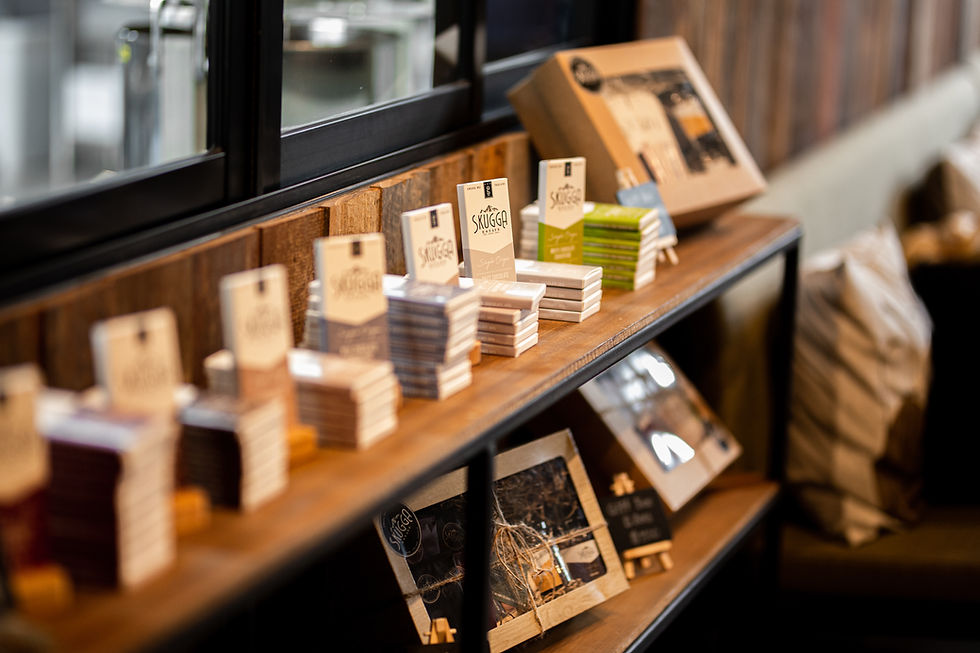
From fermentation experiments inspired by specialty coffee to the rise of global inclusions, emotional micro-celebrations, and the quiet luxury of a well-designed wrapper, craft chocolate in 2026 is the most interesting it has ever been.
Something is happening in the world of craft chocolate, and it goes beyond flavour. The category is being reshaped by a convergence of forces: rising cocoa prices creating financial pressure on makers, post-pandemic consumers with sharper palates and stronger opinions, and a global food culture that has never been more cross-pollinated. The result is a bar landscape that is bolder, more personal, and more intellectually serious than at any point in the craft movement's history. We pulled together intelligence from industry insiders, international trend research firms, and on-the-ground makers to map exactly where things are heading. If you want to taste your way through these trends firsthand, our Chocolate Bar is a good place to start.
TREND 01
Tea and Coffee Move to the Centre of the Bar
The pairing of fine chocolate with the world's two other great beverage commodities, tea and coffee, is accelerating from a niche curiosity into a defining craft movement. Tea-infused chocolate is now one of the fastest-growing flavour directions in specialty chocolate, with makers pairing specific teas with complementary inclusions to build layered, aromatic profiles that unfold over several seconds on the palate. There is, as one importer put it recently, endless room to explore.
Spotlight: Chiang Mai on the Global Stage
Seattle chocolate importer Ella Selfridge of The Chocolate Squirrel recently pointed to KanVela Tree to Bar Chocolate out of Chiang Mai as a benchmark example of this trend executed with real conviction. KanVela's Milk Chocolate Southern Thai Tea with Crispy Roti (55%) layers spiced southern milk tea into 55% milk chocolate alongside bits of crispy roti, building a bar that is unmistakably local in DNA while speaking a universal craft language.
That a Chiang Mai maker is being cited by North American industry insiders as a global reference point says something significant about the elevated standing of Thai craft chocolate right now. The world is paying attention. We explore bars like this regularly in our Chocolate Lab.
On the coffee side, the expectation among insiders is that the relationship between cacao origin and coffee origin will become increasingly intentional: pairing beans from the same country or micro-region to create a terroir-driven double act. Belgian makers Mike & Becky have shown the way with their Oat Cappuccino bar, pairing Colombian Santander coffee with 66% Dominican cacao from Oko Caribe. Italian maker Karuna Chocolate builds a similar story with their organic 68% dark bar, marrying Belize cacao with Belize Arabica coffee. The two-origin harmony is a concept borrowed from wine. It has arrived in chocolate.

TREND 02
Inclusion Bars Get a Global Passport
Inclusion bars, those featuring nuts, fruit, seeds, flowers, spices, and other add-ins, are now the most commercially dynamic format in craft chocolate. The reason is partly financial: with global cocoa prices elevated, a well-filled bar uses slightly less chocolate per unit while delivering higher perceived value. But there is a deeper cultural story at work here.
Consumers shaped by global food media, international travel, and cross-cultural dining are bringing new flavour fluency to their chocolate buying. Makers are meeting that knowledge head-on. Combinations gaining real traction right now include soy praline, yuzu, miso caramel, guava, chili lime, pear sake, tamarind, and Kampot pepper. Ingredients like baru nuts from South America, Shangri-la Red Gala apples, black and white sesame, and Andean rose are appearing in limited-edition bars from makers who want to signal both sourcing intelligence and creative range.
"Gen Z and younger millennials gravitate toward culinary playfulness. They are not intimidated by durian chocolate or pineapple tatin. They grew up eating the world." — Erwin Chen & Séverine Moreau, Mellis Chocolate, Toronto
Global flavour research drawing on consumer data from 24 countries confirms this directionally. Flavour ingredients from Asia, the Middle East, and Latin America are now a primary innovation driver across the entire chocolate category. The viral Dubai pistachio bar of 2024 was not a blip. It was a threshold moment that permanently expanded what consumers believe a bar can contain. Craft makers were already there. Now the broader market has caught up with them.
TREND 03
The Better-For-You Bar Is No Longer a Compromise
The wellness turn in food has reached craft chocolate with real force, and this time it is not a passing phase. High-percentage bars, 80%, 90%, and even 100% cacao, are moving from the margins to the mainstream of specialty retail. The driver is consumer sugar awareness: people who have already discovered craft chocolate now want to go deeper into the product. They are finding that very high cacao bars offer not just a health rationale but a genuinely more complex tasting experience. The bitterness is not a punishment. It is the point.
83% of global chocolate buyers now look for shorter, cleaner ingredient lists when purchasing chocolate confectionery, up sharply from previous years. Clean label has become a baseline expectation, not a premium differentiator.
The next development insiders are watching: 100% cacao bars paired with fruit and nut inclusions to soften the intensity and broaden the audience. The logic is elegant. Let the inclusions do the sweetness work while the chocolate itself remains pure. DesBarres Chocolate founder Ariane Hansen, whose Canadian brand specialises in high-percentage single-origin bars, reports that demand from experienced chocolate consumers for sugar-minimal options is stronger than it has ever been.
Mintel's research adds an unexpected layer to this story: the mainstreaming of GLP-1 medications is creating a new consumer segment that actively seeks smaller, more intense, nutritionally conscious indulgences. For craft chocolate makers already working at higher cacao percentages, this is an unlooked-for tailwind. You can explore high-percentage bars worth knowing about in our Chocolate Lab.

TREND 04
Texture Becomes a Language of Luxury
Across every level of the market, from artisan bean-to-bar makers to major confectionery brands, texture has emerged as the primary battleground for consumer excitement. Innova Market Insights flags "Layers of Delight" as one of the defining innovation forces in chocolate right now. Consumers are actively seeking products that balance taste, texture, wellbeing, and emotion in a single experience. They want a bar that tells a story with every bite, not just every swallow.
The numbers are striking. Search volumes for "chocolate bar fillings" increased by 191% in Q2 2025 alone. The viral Dubai chocolate, with its pistachio cream interior and crispy kataifi-dough shell, taught a generation of consumers to expect textural drama from a bar. That expectation has not faded. In 2026, it is driving genuine technical innovation: aerated chocolate structures, contrasting crunchy-to-molten transitions, layered ganaches with unexpected inclusions, and fillings engineered to create a specific moment of surprise. These are not accidents. They are design decisions.
For craft makers, this is terrain they have always inhabited. The difference now is that broader consumer culture has finally caught up with them.
TREND 05
Fermentation Experiments and the Coffee Playbook
The most technically ambitious direction in craft chocolate right now draws direct inspiration from specialty coffee. Where coffee producers have spent the past decade developing anaerobic fermentation, co-fermentation, thermal shock processing, and wild starter yeast techniques to unlock previously inaccessible flavour complexity, cacao farmers and chocolate makers are beginning to explore the same territory. The parallels between the two industries are too compelling to ignore.
"Anaerobic fermentation, co-fermentation, thermal shock, wild starter yeasts, added enzymes. The techniques coffee has pioneered are now moving into cacao. The flavour possibilities are genuinely new." — Erwin Chen & Séverine Moreau, Mellis Chocolate
These techniques are not yet in wide commercial production. They exist in the research kitchens of ambitious makers and at progressive cacao farms in Peru, Vietnam, and parts of West Africa. But they signal clearly where flavour-forward innovation is heading over the next five to ten years. Combined with sustained collector interest in rare micro-origin cacao and microbatch productions, the top tier of the craft chocolate market is developing the kind of connoisseurship that fine wine has long enjoyed. The vocabulary of terroir, once borrowed awkwardly from viticulture, is beginning to fit chocolate like it was always meant to.

TREND 06
Packaging as Product: The Wrapper Does the Work
With bars shrinking in size and rising in price, the packaging surrounding craft chocolate is becoming a more important part of the purchase decision than most makers have historically acknowledged. Consumers are making considered buys. They want to feel that the object in their hands is worth the investment. In the gift-giving context, which drives a significant share of craft chocolate sales, the wrapper, box, or format does as much persuasive work as the contents. Sometimes more.
DesBarres Chocolate's Ariane Hansen is direct about this: for consumers who are not already deeply engaged with cacao origins and processing philosophy, packaging may eventually matter more than any other element of the craft. Their own bars increasingly highlight the flora, fauna, and cultural signatures of specific cacao regions, telling a story through visual design that connects the buyer to a place before they have tasted a thing. The wrapper is the first bite.
One in three chocolate buyers is willing to pay a premium for sustainably packaged chocolate, with recyclable and low-waste materials now cited as a purchase driver alongside taste and origin.
Alongside premium formats, mini-bars and half-sized offerings are growing as a way to make craft chocolate accessible at a lower entry price. A 20g bar functions as a try-before-you-commit format. It broadens the market without diluting the brand, and for makers navigating rising ingredient costs, it is a pragmatic and strategically sound addition to the range.
TREND 07
Chocolate for Everyday Moments, Not Just Occasions
Barry Callebaut's 2026 trends report, produced in partnership with global forecaster WGSN and drawing on 24,000 consumers across 24 countries, identifies what may be the most culturally significant shift in chocolate consumption right now: the move away from major calendar occasions toward what they call "minorstones".
The minorstone concept refers to the small, personal victories and transitions that now warrant their own moment of marking: a promotion, finishing a difficult project, a child's first week at school, a quiet Friday well survived. Consumers are reaching for quality chocolate not as a grand gesture but as a personal punctuation mark in ordinary life. This creates a genuine opportunity for craft makers to position their bars not just as gift objects but as habitual, intentional purchases made for the self.
The implication for format and communication is significant. Brands that speak to everyday emotional life, rather than only seasonal gifting, are accessing a purchasing behaviour that operates 365 days a year, not just in four retail peaks. Industry analysts project the global chocolate market to top $245 billion by 2031, powered by exactly this kind of deepening, more personal relationship between consumers and the category.
What connects all seven of these directions is a single underlying truth: consumers in 2026 are bringing more knowledge, more curiosity, and more emotional investment to their chocolate buying than ever before. That is excellent news for anyone making chocolate with genuine intent.
The best craft chocolate right now is not trying to compete with mass-market confectionery on price or convenience. It is doing something that mass production cannot replicate: it is specific. Specific to a place, a fermentation style, a cultural flavour tradition, a maker's obsession. That specificity is the value. And the market, slowly but unmistakably, is beginning to pay for it.
For those of us fortunate enough to live somewhere like Chiang Mai, where a world-class tree-to-bar maker is a short ride from the old city, where Thai tea is a daily ritual rather than an exotic ingredient, and where the proximity to extraordinary cacao-growing regions across Southeast Asia gives the whole thing a local resonance, this is a particularly good moment to be paying attention to what is happening in the world of craft chocolate. The bar has never been higher. And it has never tasted better. Browse what we are drinking and eating at the Chocolate Bar, or go deeper with our tasting notes in the Chocolate Lab.
Sources


Comments