
The Quiet Rise of Thai Chocolate
- Skugga Editorial Team

- Jun 29
- 4 min read

Most people who visit Thailand come back talking about the food. The curries, the street noodles, the fruit. Rarely the chocolate. That is about to change.
Thailand produced more than 3,100 tonnes of raw cocoa beans in 2025, nearly 40 per cent more than the year before. Exports of cocoa and chocolate products hit US$131 million last year. Japan and China, two of the world's most discerning food markets, both saw Thai chocolate export growth of over 40 per cent in a single year. These numbers do not describe a cottage industry. They describe a country that has quietly figured something out.
The interesting part is how it happened, and where it is heading.
The chocolate world has a problem
Two countries, Côte d'Ivoire and Ghana, produce more than 60 per cent of the world's cocoa. The chocolate bars you grew up eating almost certainly started there. For decades this worked. Mass production, low cost, consistent volume. But the system is under pressure from multiple directions at once.
Climate change is making both regions less reliable for cacao cultivation. Cocoa prices peaked above US$12,600 per tonne in late 2024, a level that would have seemed implausible five years earlier. Meanwhile, the buyers who care most about quality, the specialty chocolate makers and the premium brands chasing them, have been asking a question the industry cannot easily answer with West African bulk beans: where exactly did this come from, and how was it grown?
A generation of chocolate consumers now asks the same questions about cocoa that wine drinkers ask about grapes. Origin, terroir, the specific farm, the fermentation method. The bean-to-bar segment of the market, where makers control every stage from raw bean to finished bar, is projected to nearly double by 2035. Premium chocolate overall is growing at roughly three times the rate of ordinary chocolate.
Into that gap, Thailand walked quietly in.
Cacao does something different here
Cacao is supposed to grow within 20 degrees of the equator, in hot and humid lowland conditions. Thailand's north breaks that rule. The highland valleys around Chiang Mai sit above 18 degrees latitude, with cooler winters, distinct seasons, and an entirely different agricultural character to the plantations of West Africa or South America.
What came out of those conditions surprised people. Thai cacao, particularly from the north, produces flavours that specialty makers describe as unusually complex: tropical fruit, spice, hints of earth, sometimes a brightness that reminds tasters of mangosteen or lychee. One Michelin-starred chef quoted in the South China Morning Post put it simply: "The Thai craft chocolate scene is super fruity, super interesting."
That complexity is not accidental. Most Thai cacao grows in agroforestry systems, sharing land with mango, banana, coconut, and other crops rather than in cleared monoculture plantations. The trees absorb the character of everything around them. No pesticides, no forest clearing, and a flavour profile that carries the fingerprint of a specific place.
In Chiang Mai, a professor named Sanh La-ongsri spent decades at Maejo University developing the I.M.1 varietal, a cross between Peruvian criollo and a Filipino forastero strain, that now grows on dozens of farms across the north. His Thailand Cocoa Center has been the quiet engine behind Chiang Mai's emergence as a credible cacao origin, and the I.M.1 beans it helped propagate are among the most sought-after in the Thai craft chocolate scene.
The makers who put Thai chocolate on the map
The clearest proof that Thai chocolate belongs in serious conversation came from the International Chocolate Awards, the most rigorous blind-tasting competition in the world. In 2022, a Bangkok micro-batch maker called PARADAi won gold at the World Final with a bar made from Chantaburi cacao. The judges named it the best dark chocolate in the world.
PARADAi has won International Chocolate Awards recognition every year since. At the 2025 World Final, two of its bars scored above 90 out of 100: the Phuket Dark 70% White Flowers and the Nakhon Si Thammarat Coconut Sugar Dark 70%. To put that in context, scores above 90 are exceptional by any global standard. The beans come from individual farms in southern Thailand, fermented on site, crafted in small batches in Bangkok's old town by two friends who rediscovered neglected cacao trees in their home province and decided to do something with them.
Multiple other Thai makers have followed. Chocoholic Thailand, Sa-rarn Chocolate, PATYA Chocolate, Kad Kokoa, Siamaya, Skugga Estate in Chiang Mai, a growing list that now runs to well over a dozen serious producers. The Academy of Chocolate in London gave silver to Thai-origin dark chocolate at its 2025 awards. The craft chocolate world has noticed, and it is paying attention.
Why this matters if you are in Chiang Mai right now
Thailand exported US$131 million worth of cocoa and chocolate products last year, according to the country's Trade Policy and Strategy Office. The government is actively pushing geographical indication status for Thai cacao, the same legal protection that gives Champagne its name and Darjeeling its identity, to anchor regional origin stories that premium buyers in Europe and Japan will pay significantly more to access.
The Thai Trade Association of Cocoa and Chocolate (TACCO), founded in 2024, now coordinates the industry's push into export markets, with China, Japan, the United States, and Europe all identified as targets. Japan and China are already responding: both saw Thai chocolate export growth of over 40 per cent in 2024.
All of this is unfolding in a country where, until very recently, most people did not know cacao grew here at all.
The Skugga Chocolate Lab
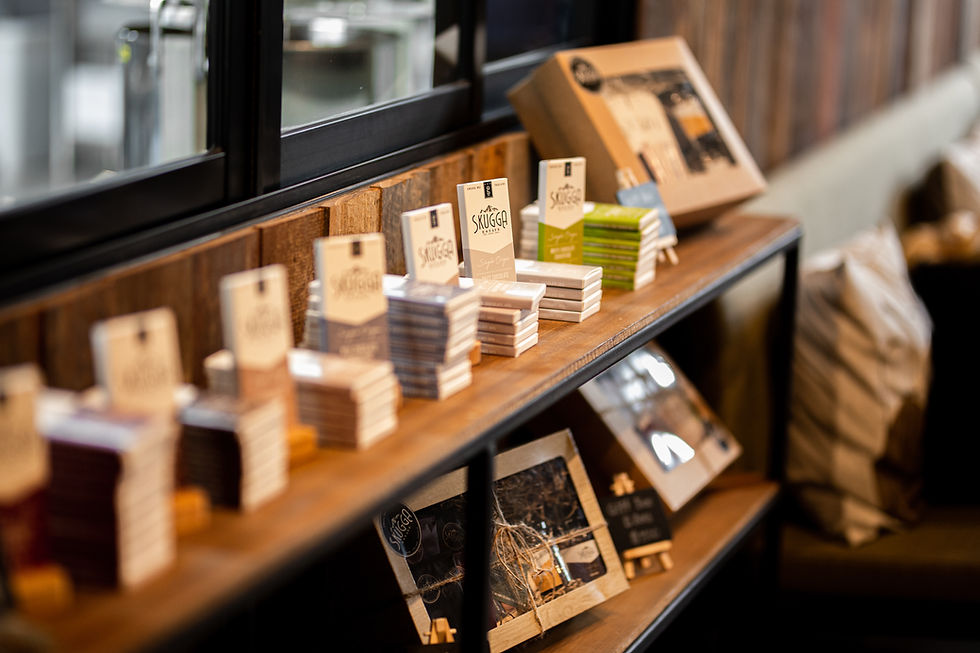
The Mae On valley, 40 minutes east of Chiang Mai Old City, sits at 410 metres in the highland corridor where northern Thai cacao grows. This is not coincidental to why Skugga Farm built a bean-to-bar chocolate lab here.
The lab works with single-origin Thai cacao, controlling fermentation, roasting, and production from the bean up. Every bar is traceable to its origin. No bulk couverture, no imported base chocolate. The process is the same one that has produced world-competition gold medals elsewhere in Thailand, applied to northern Thai cacao with the terroir that makes it worth doing.
When you visit the lab, you are not watching a chocolate factory. You are watching an argument being made in real time: that Thailand belongs on the same shelf as Ecuador, Madagascar, and Peru when serious chocolate drinkers are choosing what to open next.
The rest of the world is starting to agree.


Comments