
What Is Carbonic Maceration Coffee? Process, Flavour, and Where to Try It in Thailand


Carbonic maceration coffee is a specialty processing method in which whole, intact coffee cherries are sealed inside pressurised tanks flooded with carbon dioxide, triggering a controlled fermentation that takes place entirely inside the fruit. The result in the cup is unlike anything produced by conventional processing: red fruits like cherry, raspberry, and plum, often backed by tropical notes such as mango, lychee, and passionfruit, with a rounded, silky mouthfeel and acidity that is bright but well behaved, sometimes with a soft, lactic edge.
The technique entered the coffee world's mainstream in 2015, when Australian barista Saša Šestić used a washed carbonic maceration Sudan Rume variety from Finca Las Nubes, Colombia — processed in collaboration with producer Camilo Merizalde — to win the World Barista Championship in Seattle. That single competition changed how producers, roasters, and serious coffee drinkers thought about fermentation. A decade later the method has moved from competition novelty into commercial production across Colombia, Ethiopia, Kenya, Costa Rica, and Northern Thailand, where the Black Pig roastery at Skugga Farm in the Mae On valley, forty minutes east of Chiang Mai, applies it to single-origin Thai arabica.
The coffee does not taste boozy despite its winemaking origins. The small amount of ethanol made in the tank almost entirely evaporates during drying and roasting, so a brewed cup carries only a trace. What survives is the aroma, not the alcohol.
The Science: What Happens Inside the Tank
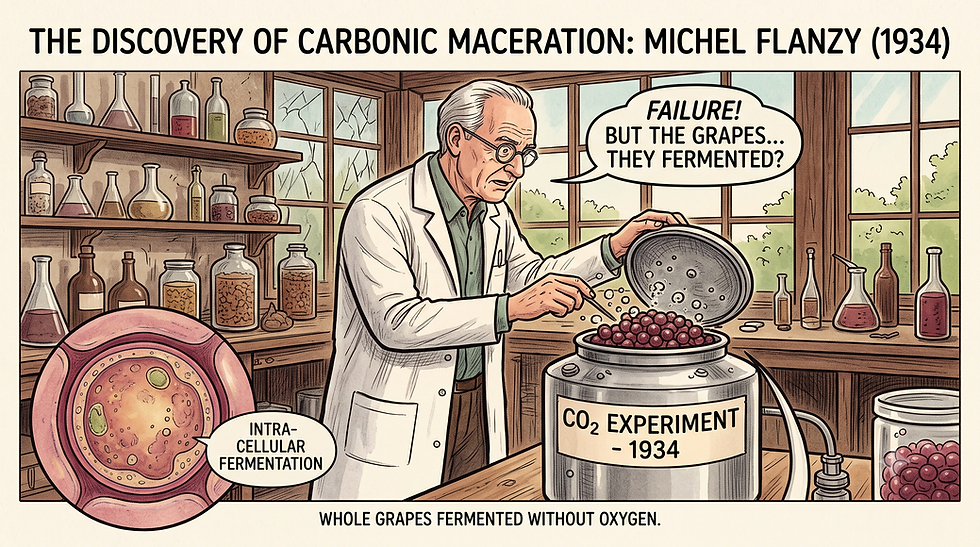
Carbonic maceration's journey from winemaking to coffee begins with an accident. In 1934, French scientist Michel Flanzy was attempting to preserve harvested grapes using carbon dioxide — the same method used to store apples at the time. The preservation failed. The grapes began to ferment unexpectedly, producing juice with low alcohol and unusual fruit character. Flanzy documented what had happened and proposed an entirely new vinification method. The technique did not gain commercial traction until the 1960s, when Jules Chauvet, a Beaujolais chemist and négociant, developed it into the process that would define Beaujolais Nouveau. Šestić drew directly on this winemaking lineage when he brought the method to coffee eighty years later.
In coffee, carbonic maceration is a form of anaerobic fermentation involving whole, not pulped, ripe coffee cherries placed in a sealed airtight vessel — typically stainless steel with a one-way valve — in an environment with no oxygen. The cherries are flooded with carbon dioxide to remove the oxygen. The one-way valve allows the pressure build-up to be released.
Because the cherry skin remains intact, aromatic compounds produced during fermentation have no way to escape. Instead, they are absorbed back into the seed, developing a flavour profile that conventional processing cannot replicate. The fermentation is intracellular: it begins inside the fruit itself, driven by the cherry's own enzymes rather than external microorganisms. The controlled anaerobic environment typically lasts between 15 and 100 hours, depending on desired flavour outcomes and environmental factors.
Temperature management is central to the entire process. Most successful protocols maintain temperatures between 15 and 22°C. Too warm and the fermentation accelerates beyond control, introducing unwanted acetic acid and off-flavours. Too cool and the process stalls. The producer is composing the cup profile in real time, adjusting variables rather than simply waiting for fermentation to finish.
Much of the character comes from esters — aromatic compounds formed when alcohols produced during fermentation react with organic acids in the fruit. The extended intracellular phase tends to produce them in abundance. Carbonic maceration is associated with higher levels of cinnamate esters in particular, which is part of why these coffees read as more aromatic and lifted than a sealed-tank anaerobic from the same farm. It is not simply more fermentation. It is a different set of compounds.
Carbonic Maceration vs Anaerobic Fermentation
The two terms appear on the same specialty coffee menus and are frequently used interchangeably. They are related, but not identical.
Anaerobic processing broadly means oxygen-restricted fermentation. Carbonic maceration is a tighter subset using a CO₂-rich sealed environment adapted from winemaking. Both push the cup towards fruit-forward, ferment-led profiles, but their microbial dynamics and volatile formation pathways differ.
True carbonic maceration specifically requires whole, unpulped, intact coffee cherries. The initial and most critical fermentation phase happens inside those cherries. Many other anaerobic coffee processes use pulped coffee or green beans without mucilage. In carbonic maceration, the environment is actively flushed and saturated with carbon dioxide from an external source at the start, ensuring a rapid onset of the desired conditions. Some anaerobic fermentations rely on the carbon dioxide produced by fermentation itself to displace oxygen gradually.
For the cup, the practical implication is this: carbonic maceration coffees tend toward brighter, more defined acidity and more aromatic intensity than traditional naturals, which lean toward heavier body and deeper fruit sweetness. Anaerobic fermentation can produce similar intensity by a different biochemical route, often with a heavier, more fermented profile. Carbonic maceration, done well, produces something cleaner and more lifted: intense but precise.
What Carbonic Maceration Coffee Tastes Like
The method amplifies and shapes the existing characteristics of the coffee: the variety, the terroir, the altitude, the ripeness of the cherry at harvest. A carbonic maceration lot from one origin tastes very different from a carbonic maceration lot from another, even when the process label is identical.
Certain characteristics repeat reliably across well-executed lots. Stone fruits — ripe peach and plum — layered with bright red fruits such as cherry and raspberry, tropical notes including mango and passionfruit, gentle floral aromatics, medium body, and a smooth, wine-like finish. The acidity is present and vivid but rarely aggressive. Carbonic maceration coffees frequently have an acidity that feels smooth and juicy rather than sharp — more like yoghurt or stone fruit than citric brightness. This is linked to the lactic acid bacteria that thrive in the carbon dioxide-rich, oxygen-free environment.
For the drinker encountering a carbonic maceration coffee for the first time, the experience is often described as a moment of recalibration. The fruit is more vivid, the aroma more perfumed, and the finish longer and more complex than conventional processing produces. The winemaking reference is more than historical. There is a genuine sensory connection between the method and the cup.
The 2015 World Barista Championship
Saša Šestić, director and green buyer at Ona Coffee in Canberra, Australia, won the 2015 World Barista Championship in Seattle using a Sudan Rume variety from Finca Las Nubes, Colombia, produced in collaboration with Camilo Merizalde. He served it as a blend of 50% natural process and 50% washed carbonic maceration as a cappuccino. The aim, in Šestić's own words, was to achieve plums, apricots, and super sweet stone fruits with sparkling acidity — not to create new flavours, but to better express what was already in the cherry and make it more distinct.
The cup stood out immediately. Clean but punchy. Fruit-forward but precise. His win played a major role in bringing carbonic maceration into mainstream specialty conversation, and in a broader shift in how producers think about fermentation — not just as a step, but as a tool.
A decade on, carbonic maceration has moved well beyond competition coffee and into commercial production around the world. Producers in Colombia, Ethiopia, and Central America offer carbonic maceration lots regularly. The method has arrived in Northern Thailand too, driven by a specialty coffee movement that has transformed the country's arabica-growing highlands over the past decade.
Thai Arabica and the Fermentation Revolution
Thailand's northern highlands have produced arabica coffee since the 1970s, when the late King Bhumibol Adulyadej's Royal Project introduced cash crops to the northern hill communities as an alternative to opium cultivation. The cool temperatures, rich soils, and high altitudes of Chiang Mai, Chiang Rai, and Doi Tung proved well-suited to arabica production, and the foundation of a specialty coffee culture was established.
The growth since has been substantial. According to Thailand's Ministry of Commerce, coffee consumption has increased from an average of 180 cups per person per year to over 340 cups, with the domestic market value reaching 65 billion Thai baht in 2025. The specialty segment is the fastest-growing part of that market, expanding at around 25% annually. By the 2025 Cup of Excellence competition, the top 15 coffees had scored 88 points or above — a clear sign of sustained quality across the country's farms.
Over the past decade there has been a clear shift among Thai coffee farmers toward producing specialty-grade coffee. Many producers are investing in better processing methods, experimenting with fermentation techniques, and focusing on varieties that achieve higher cup scores. Carbonic maceration fits that ambition. It fits the pace of a coffee culture that has moved rapidly from commodity production to craft processing, and it fits a domestic market now sophisticated enough to appreciate what controlled fermentation produces in the cup.
Where to Taste It: The Black Pig Roastery, Mae On
The Black Pig roastery at Skugga Farm processes single-origin Thai arabica using carbonic maceration. The farm sits in the Mae On valley, forty minutes east of Chiang Mai Old City, at an elevation that gives the growing season the cool nights and diurnal temperature variation that build acidity and complexity in the cherry before processing begins. The soil is volcanic and granitic. The arabica is shade-grown. The base material, before a single tank is sealed, is already doing things that flatland growing cannot replicate.
The connection between the Black Pig and the wider estate is not incidental. The same principle — that controlled fermentation produces complexity the raw material alone cannot — runs through the bean-to-bar chocolate laboratory on the farm site and through the developing wine programme at Skugga Estate Vineyard, 1.5 kilometres down the valley, where vines planted in 2025 in Mae On's volcanic soils are guided by a viticulture team with roots in New Zealand winemaking. Carbonic maceration in the coffee, controlled fermentation in the chocolate process, and the early stages of a tropical wine programme — all on the same site, all drawing on the same underlying idea.
For visitors arriving from Chiang Mai, the farm is a morning well spent. The pour-over tasting flight at the Black Pig lets the carbonic maceration processing speak for itself: the stone fruit, the lactic acidity, the aromatic lift that distinguishes this method from anything a washed or natural process produces. The Classic Car Gallery and the chocolate lab are on the same site. Entry to the farm is free. The single-origin Thai chocolate produced in the lab next door uses the same fermentation logic as the coffee in your cup.
How to Brew It at Home
Pour-over methods, at slightly lower temperatures than standard, with a medium grind, tend to showcase the stone fruit and floral notes without overwhelming the palate. Dropping one to two degrees from a standard 93°C extraction temperature rounds the profile and brings the fruit forward. For espresso, a slightly faster extraction — 19 to 20 seconds — tends to produce the balance of sweetness and sparkling acidity that carbonic maceration coffees are capable of at their best.
Buy from a roaster who can tell you the fermentation duration, the cherry variety, and the post-tank drying method. A lot described simply as "carbonic maceration" without further detail gives you less to work with than one that specifies 72 hours of tank fermentation followed by raised-bed washed drying. The more precise the information, the more the roaster understands the process. If you want to understand what carbonic maceration actually tastes like before buying a bag, tasting it at the point of production — at a farm roastery such as the Black Pig in Mae On — gives you a reference point that no tasting note on a label can fully replace.
Frequently Asked Questions
What is carbonic maceration coffee?
Carbonic maceration coffee is a specialty processing method in which whole, intact coffee cherries are placed in sealed tanks flooded with carbon dioxide. The oxygen-free environment triggers fermentation inside the fruit itself, producing aromatic compounds that result in a cup with vivid stone fruit and tropical fruit character, bright lactic acidity, and a complex, wine-like finish. The technique is borrowed from winemaking, where it was discovered accidentally by French scientist Michel Flanzy in 1934.
How is carbonic maceration different from anaerobic fermentation?
Both methods involve oxygen-restricted fermentation inside sealed tanks. Carbonic maceration is a specific subset that requires whole, unpulped coffee cherries and active flushing with carbon dioxide from an external source at the start of the process. Most anaerobic fermentations allow carbon dioxide produced by fermentation itself to displace oxygen gradually, and may use pulped rather than whole cherries. The distinction produces a different set of aromatic compounds in the cup: carbonic maceration tends toward brighter acidity and more lifted, aromatic intensity.
What does carbonic maceration coffee taste like?
The most common flavour characteristics are stone fruits such as peach and plum, red fruits such as cherry and raspberry, tropical notes including mango and passionfruit, and floral aromatics. The acidity is typically bright but smooth rather than sharp, often described as juicy or lactic. The mouthfeel is rounded and silky. The overall profile is expressive and complex in a way that distinguishes it clearly from washed or natural coffees from the same origin.
Where did carbonic maceration in coffee originate?
The technique entered specialty coffee in 2015 when Australian barista Saša Šestić used a washed carbonic maceration Sudan Rume variety, in collaboration with Colombian producer Camilo Merizalde, to win the World Barista Championship in Seattle. Šestić drew directly on carbonic maceration winemaking techniques first documented by French scientist Michel Flanzy in 1934. The 2015 championship win brought the method to global specialty coffee attention and set off a decade of producer experimentation across multiple origins.
Can you taste carbonic maceration coffee in Chiang Mai?
Yes. The Black Pig roastery at Skugga Farm in the Mae On valley, forty minutes east of Chiang Mai Old City, processes single-origin Thai arabica using carbonic maceration and serves it as a pour-over tasting experience. The farm is open daily with free entry. It is one of the few places in Southeast Asia where you can taste carbonic maceration coffee at the point of production, alongside a bean-to-bar chocolate lab and a developing estate wine programme that shares the same fermentation philosophy.
What makes carbonic maceration coffee more expensive than conventionally processed coffee?
The method requires sealed stainless steel fermentation tanks, precise temperature control systems, active monitoring throughout the fermentation window, and careful sensory evaluation at every stage. The equipment investment, labour intensity, and higher rate of batch failure compared to conventional processing all contribute to a higher price per kilogram. For coffees that pass quality control, the flavour difference from a conventionally processed lot of the same variety and origin is material and immediate. The process rewards producers who get it right with cups that compete at the top of the specialty market.
Skugga Farm is a specialty farm and roastery in the Mae On valley, forty minutes east of Chiang Mai. The Black Pig roastery processes single-origin Thai arabica using carbonic maceration, alongside a bean-to-bar chocolate laboratory and a Classic Car Gallery holding fifteen British vehicles. Skugga Farm is open daily with free entry. Skugga Estate Vineyard, 1.5 kilometres down the valley, offers fine dining, estate gin, ceremonial cacao, and a developing wine programme. Contact the estate at vineyard@skuggalife.com.


Comments